
Saijōtai Yamata[i]-K[h]itan No. 2 罪狀體邪馬臺綺譚 其二
for percussion and vocal actor
9′
Program Notes
The earliest surviving version of this piece was composed by the Italian Pérotin during his French period. According to unofficial chronicles, it briefly caused a sensation throughout Europe. Marco Polo carried a copy on his travels in the East. After reaching the Korean peninsula, he encountered a giant shellfish at sea. The shellfish exhaled a cloud of mist, within which a mountain could faintly be seen, radiating light in five colors. A monk residing halfway up the mountain recovered the manuscript and translated it into a now-extinct Sinitic language. In this language, all nouns were temporary and could be declined only during certain astronomical events. The shellfish subsequently made landfall on the coast of Mino Province. Only the translation was brought ashore.
For the next several centuries, the manuscript remained in the possession of a Japanese noblewoman who was both a collector and a scholar. She issued Turandot-like riddles to the world, seeking a means of deciphering the language. Her private notes indicate that the work still comprised seven movements at the time. Her published findings took the form of an esoteric chart documenting the principal misinterpretations of the manuscript. I have translated it into English and placed it below.
During the Second World War, a Japanese general brought the manuscript to Shanghai in hopes of repairing its grammar. Several copies were made, one of which passed into the hands of a wealthy merchant. After a brief period of commercial success in Indonesia, the merchant emigrated to North America before the end of the war, preserving his copy intact. The other versions appear to have been looted by anonymous collectors or lost in the fighting. During the Cold War, Soviet authorities captured a shellfish in the southern part of the Chukotka Autonomous Okrug and obtained information about the work through what may have been torture. At the time, the last surviving copy was held by an unemployed musicologist in New Mexico. Upon learning of this, he quickly committed the manuscript to memory and burned it.
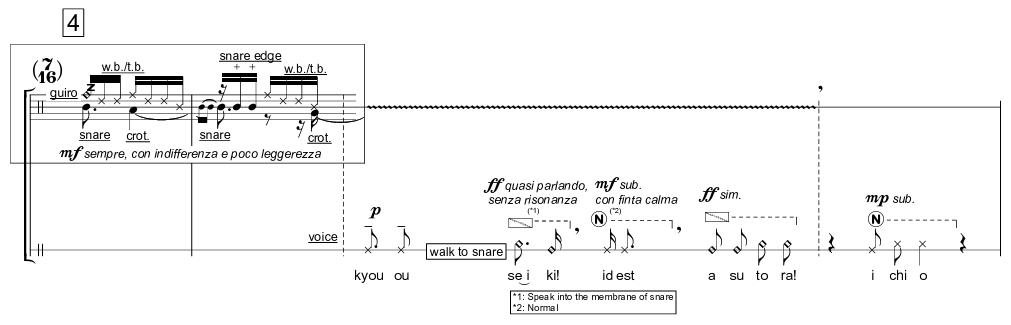
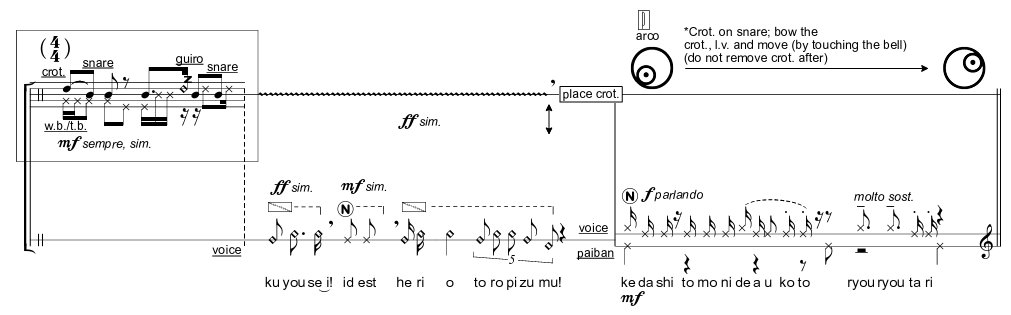
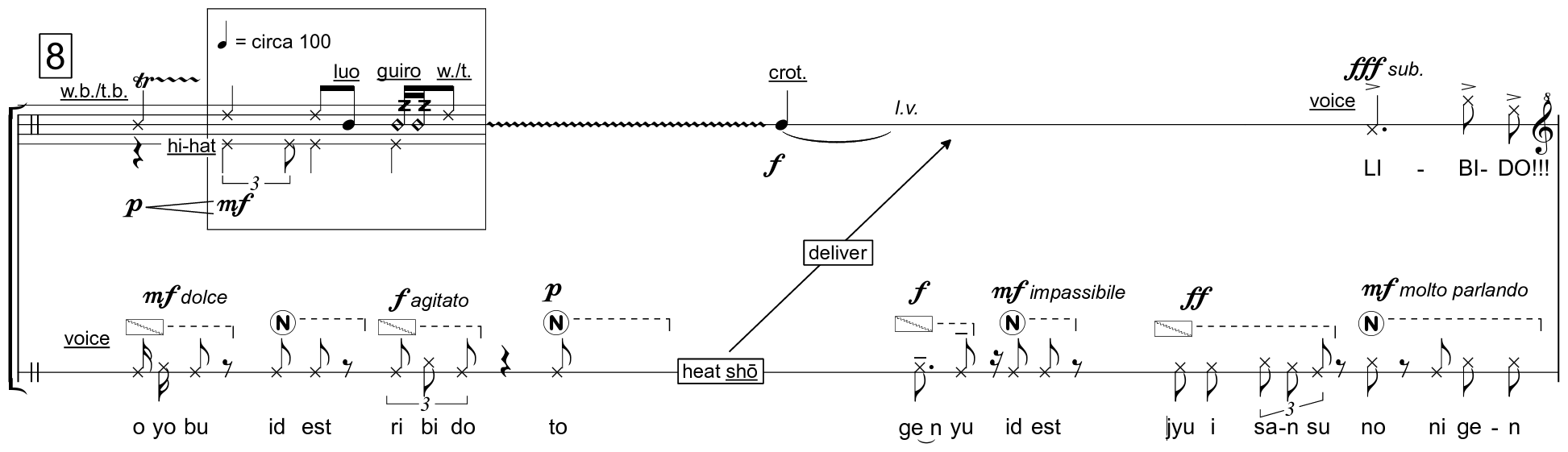
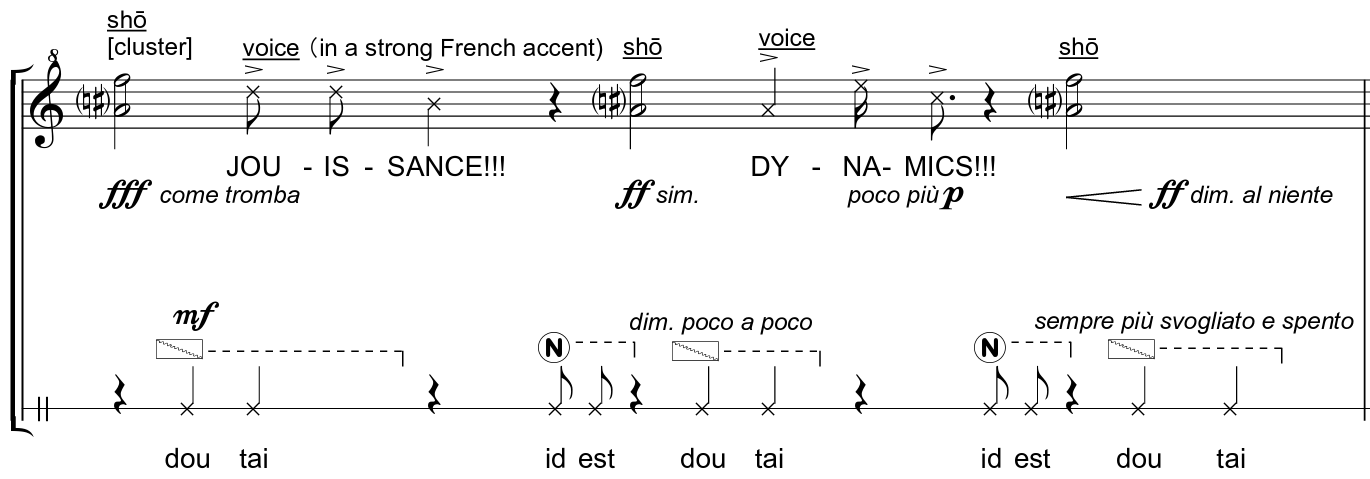
I was fortunate to transcribe the entire work on the day before the musicologist’s death. He remained lucid throughout. His last words were:
sempre ad lib. e espr. assai…
節目說明
現存最早的版本由義大利作曲家 佩羅坦 於其法國時期寫成,據野史記載一時轟動歐洲。馬可波羅在東方旅行時也攜帶了一份抄本。在他抵達朝鮮半島後,他在海上遇見了一隻巨大的貝類,貝吐出一團迷霧,迷霧中隱約有一座發著五種顏色的光的山。一位半山腰的僧人拾得手稿,將其譯為一種現已滅絕的漢語族語言。在這種語言中,所有名詞都是臨時的,只能在一定的天文學事件下變格。隨後,這隻貝登陸美濃國一處海岸,只有譯稿被帶上了陸地。
此後數百年間,手稿一直由一位日本貴族女性收藏家兼學者持有。她以圖蘭朵式謎題的形式向天下尋求這一語言的破譯方式。從她的手記來看,彼時全曲還有七個樂章。她公開發表的成果,是一張關於手稿主要誤解的秘傳圖表。我已將其譯成英文,置於下方。
第二次世界大戰期間,一位日本將軍將手稿帶往上海,希望修復它的語法。其間製作了數份抄本,其中一份落入一位富商手中。富商在印尼短暫地獲得了商業成功後,在戰爭結束之前移居北美,得以將抄本保持完整,而其他版本似乎都被匿名藏者劫掠或消失在戰火之中。冷戰期間,蘇聯在楚科奇自治區南部捕獲了一隻貝類,以或許是拷問的手段得知了這部作品的資訊。彼時,最後的抄本在新墨西哥州的一個未就業的音樂學家手中。他得知這一消息後,迅速背誦下了這個手稿的內容並將其燒毀。
我有幸在這名音樂學家去世的前一天,將全曲轉錄下來。他始終神志清醒。他的遺言如下:
sempre ad lib. e espr. assai…
Text (Right to Left)
罪状體邪馬臺綺譚 其二